July 13, 2026 · 9 min read
What Submerged Vehicles Look Like on Side-Imaging Sonar
How vehicle geometry, orientation, acoustic shadows, bottom type, and partial burial affect a side-imaging sonar return during underwater search and recovery.
By HumVision Team · HumVision
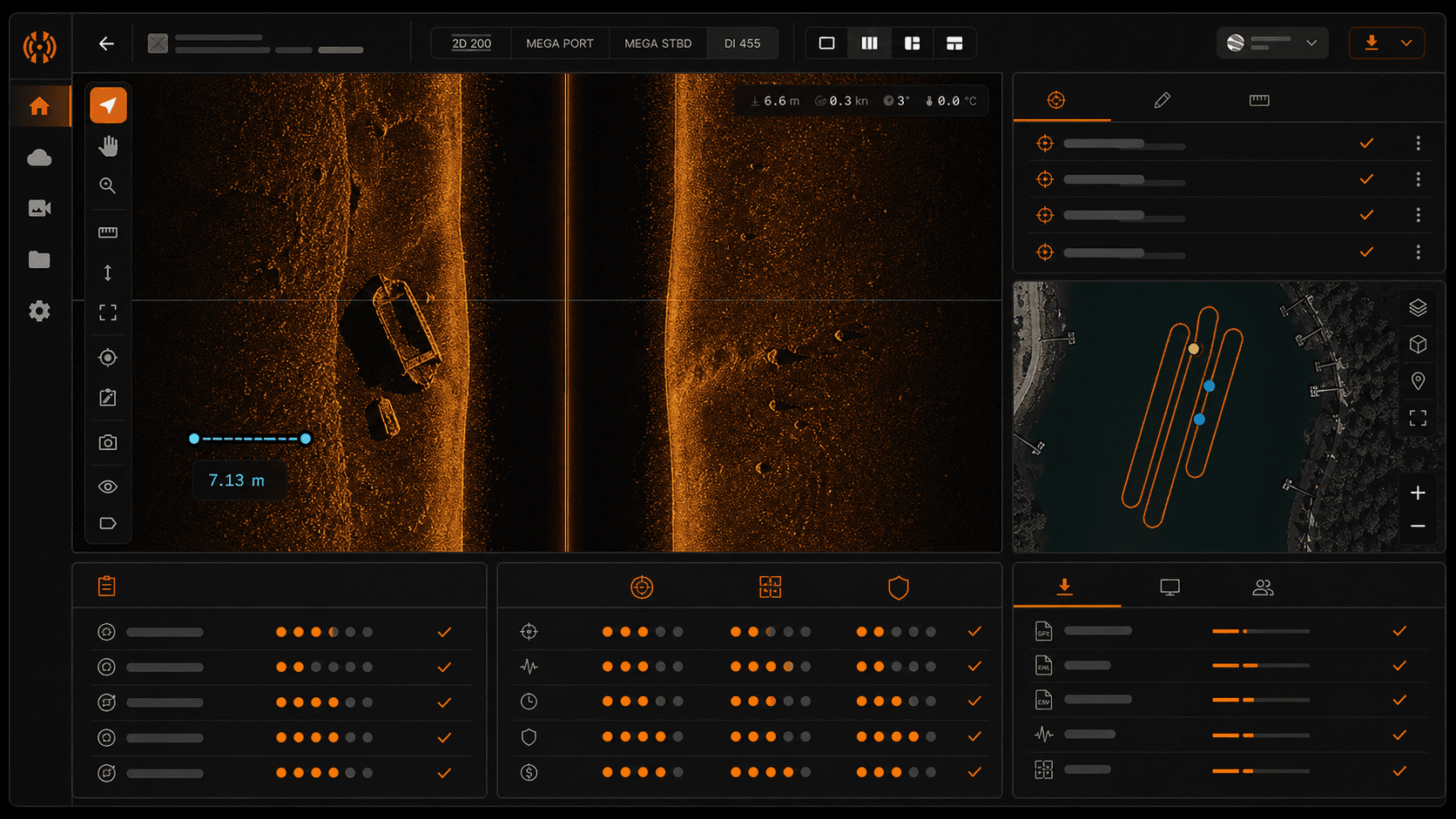
A submerged vehicle seldom appears as a complete, familiar car outline on Side Imaging. The sonar records reflected sound one slice at a time while the boat moves. The final image may show a bright rectangular mass, a separate cabin or roof return, one visible end, and an acoustic shadow that explains more than the object itself.
Ask which visible features support a vehicle classification and which other objects could produce them. That keeps the review tied to acoustic evidence instead of a familiar outline.
Start with the way Side Imaging builds the picture
Humminbird Side Imaging sends a thin beam to port and starboard. Each return becomes one narrow slice of the display. Forward boat motion places those slices next to each other, building a view of the bottom already passed by the boat. Humminbird's Side Imaging guide identifies the center as the water column and the outer portions as the bottom on each side.
This geometry affects every vehicle image. The long axis of the display represents the boat's travel over time. The cross-track axis represents range away from the boat. A target lying parallel to the track is sampled from a different sequence of angles than one lying across it.
Color does not identify the object. Different palettes reverse or remap the display tones. Focus on edges, return strength relative to the surrounding bottom, shadow, scale, and position.
Look for vehicle-scale geometry
A vehicle is a collection of broad panels, cavities, edges, and curved surfaces. Sonar may combine those parts into a few dominant features rather than drawing every component.
Common evidence includes:
- A rectangular or elongated main mass with proportions consistent with a passenger vehicle, truck, or utility vehicle.
- A raised central section that may correspond to the cabin or roof.
- A change in width between the passenger compartment and the front or rear of the vehicle.
- Parallel edges that persist across adjacent pings.
- A shadow with a length and outline consistent with a body raised above the bottom.
- Separate strong returns from exposed corners, axles, bumpers, or other surfaces facing the transducer.
These are classification clues. They are not a parts checklist. Sediment, damage, doors, broken glass, open panels, vegetation, and the direction of the beam can hide expected features.
The U.S. Coast Guard included an automobile in its side-scan sonar target-interpretation manual, alongside an aircraft, boat, and buoy. That choice reflects the central challenge: operators learn a target by studying its acoustic signature across known examples, not by waiting for a photographic silhouette.
Roof and cabin returns
An upright vehicle may present the roof or upper cabin as a raised return separated from the lower body by changes in intensity. The cabin can also affect the shadow, leaving a taller section behind the middle of the target.
That pattern becomes less clear when the vehicle rests on its side or roof. A side-resting vehicle may show one tall flank with a broad shadow. A roof-resting vehicle may have a lower profile because the cabin is pressed into the bottom while the undercarriage faces the sonar.
Do not assume the brightest area is the roof. A surface returns sound strongly when its angle sends energy back toward the transducer. Another panel at a poor angle may appear weak even if it is closer to the surface.
Wheels and undercarriage
Wheels are useful when they are resolved, but they are not required for a vehicle classification. Depending on range, frequency, target angle, and burial, a wheel may appear as a small curved return, a gap along the body, part of the shadow edge, or nothing distinct.
An exposed undercarriage can create a rougher, more complex return than the broad body panels. Axles, suspension, exhaust components, and open space beneath the chassis break up the echo. Debris and damage can create the same kind of visual complexity, so this feature needs support from the object's overall geometry.
If the review depends on seeing four clear circles, the standard is too narrow. Many valid vehicle contacts will not provide that view.
Orientation changes the acoustic signature
The same vehicle can look different on two passes because the beam strikes it from a different side.
Parallel to the boat track: The return may preserve more of the vehicle's length. Long edges can be easier to follow, though the ends may blend into surrounding bottom.
Across the boat track: Width and cabin height may be more apparent. The vehicle can look shorter because each narrow slice encounters a different cross-section as the boat advances.
At an angle: One corner may dominate the return. The far side can be hidden by acoustic shadow, producing an incomplete outline.
On its side: Height above the bottom may increase, creating a pronounced shadow. The visible body can resemble a wall or box rather than a car.
Upside down: The undercarriage may face the transducer while the roof is compressed into sediment. The familiar cabin outline may disappear.
Orientation is one reason a deliberate second pass can help. A new approach angle changes the evidence. It should not be used to force the first interpretation.
Read the acoustic shadow separately
An object protruding above the bottom blocks sound from reaching the area behind it. That no-return area forms an acoustic shadow. NOAA notes that objects rising from the seafloor produce strong returns and shadows, which helps surveyors depict seafloor objects.
For a possible vehicle, inspect:
- Where the shadow begins relative to the bright return.
- Whether the shadow follows the object's full length or only one raised section.
- Whether the outline suggests a cabin, open door, or irregular damage.
- Whether terrain, vegetation, or a second object interrupts the shadow.
- Whether the shadow remains coherent across adjacent pings.
A long shadow means the object stands above the bottom relative to the beam geometry. It does not establish the object's category. A stump, concrete structure, dock section, appliance, or rock ledge may also cast a strong shadow.
HumVision can estimate height from a clear side-scan shadow using depth, horizontal range, and shadow length. The measurement depends on accurate placement of the shadow base and tip, so save it as an estimate and note any uncertain edge.
Bottom type changes what remains visible
On a flat, even bottom, a vehicle-scale object has clean visual separation. On rock, riprap, timber, or discarded debris, its edges and shadow may merge with other returns.
Soft sediment creates a different problem. A vehicle can settle into mud or silt until only the cabin, upper body, or one end remains exposed. Sediment may cover sharp edges and reduce the apparent height. Scour around the body can add dark or bright shapes that belong to the bottom rather than the vehicle.
Vegetation can break up the outline or fill the acoustic shadow with small returns. Current can collect branches and other material against the upstream side. A vehicle that has been submerged for some time may therefore present as a combined target instead of an isolated chassis.
Document the surrounding bottom before measuring the object. A contact box that includes a scour depression, debris pile, or merged log will overstate its dimensions.
Common vehicle false positives
Several objects can produce vehicle-scale geometry:
Large appliances and tanks can show a rectangular or cylindrical body with a clean shadow. Their proportions and lack of a raised cabin may separate them from a vehicle, but damage can blur that distinction.
Concrete culverts and barriers can create strong edges and long shadows. Look for repetition, alignment with infrastructure, and a uniform cross-section.
Dock sections and small boats may have similar length and broad planar surfaces. Construction pattern, nearby anchors, shoreline context, and a second angle can help.
Logs and root masses can form a long main return with a dense raised section. Branches, taper, and irregular texture may become visible on closer review.
Rock ledges can create a straight bright face followed by a large dark area. Continue through nearby pings and inspect the broader bottom contour before treating the ledge as a separate object.
Debris piles can accidentally form a rectangular boundary from one direction. A second pass often breaks the apparent shape into unrelated items.
The reviewer should keep at least one plausible alternative in the notes until another view removes it.
Confirm the contact from another view
First, inspect the pings before and after the clearest frame. Fixed geometry should develop consistently as the boat passes.
Then compare the available channels at the same ping. A vehicle far to one side may not appear in Down Imaging or 2D because those beams did not cross it. If a follow-up pass travels over the position, the down-looking channels may provide a second view of height, bottom contact, and structure.
A second Side Imaging pass from another direction can reveal the hidden side of the target and test whether the shape repeats. Preserve both recordings and compare position, scale, outline, and shadow. If the target seems to move or disappears under similar coverage, recheck the coordinates and first-pass interpretation.
The procedure in How to verify a suspected sonar target before sending divers covers channel checks, measurements, GPS review, confidence, and handoff in detail.
Document what the sonar supports
A useful contact record separates observation from classification.
Observation: "Elongated return on starboard Side Imaging. Raised center section. Continuous shadow. West end merges with sediment."
Measurement: Record only visible length, width, and estimated height. Note where burial or shadow overlap limits an edge.
Classification: "Possible passenger vehicle" or "vehicle-like target," with a Low, Medium, or High confidence rating.
Position: Save the ping, recorded depth, and coordinates. Inspect the GPS track for jumps or missing points before export.
Alternatives: Name the strongest competing explanation, such as a dock section or debris pile.
That record is more defensible than "car found" attached to a single screenshot. It also gives the next reviewer a clear place to disagree.
HumVision provides synchronized channel review, target measurements, shadow-height estimates, contact notes, confidence ratings, and KML export for recorded Humminbird data. Start a trial with a training pass over a known vehicle or vehicle-sized object, then compare how the return changes from more than one direction.
Frequently asked questions
Can Side Imaging identify the make or model of a submerged vehicle?
Usually no. Sonar may support a general vehicle classification and rough dimensions. Damage, orientation, burial, range, and image resolution make make-and-model identification unreliable without another confirmation method.
Can Side Imaging show whether a vehicle is upright?
It can provide evidence through overall geometry and shadow height. An upright cabin, exposed undercarriage, or tall side-resting body may produce different signatures. Treat orientation as an interpretation to test from another angle.
Does a metal vehicle always produce the brightest return?
No. Echo strength depends on surface angle, range, frequency, bottom, and display settings as well as material. Brightness alone is not a reliable metal detector.
Can sonar show whether someone is inside the vehicle?
Side Imaging does not provide a reliable basis for that conclusion. State what is visible in the sonar and leave occupant determination to the authorized confirmation and recovery process.
In This Article
Share
30-day free trial
Try HumVision Team
Real recording. Real case. 30 days. No charge if it doesn't fit.
Start your free trial